The Mortgage Payment Formula Explained Simply
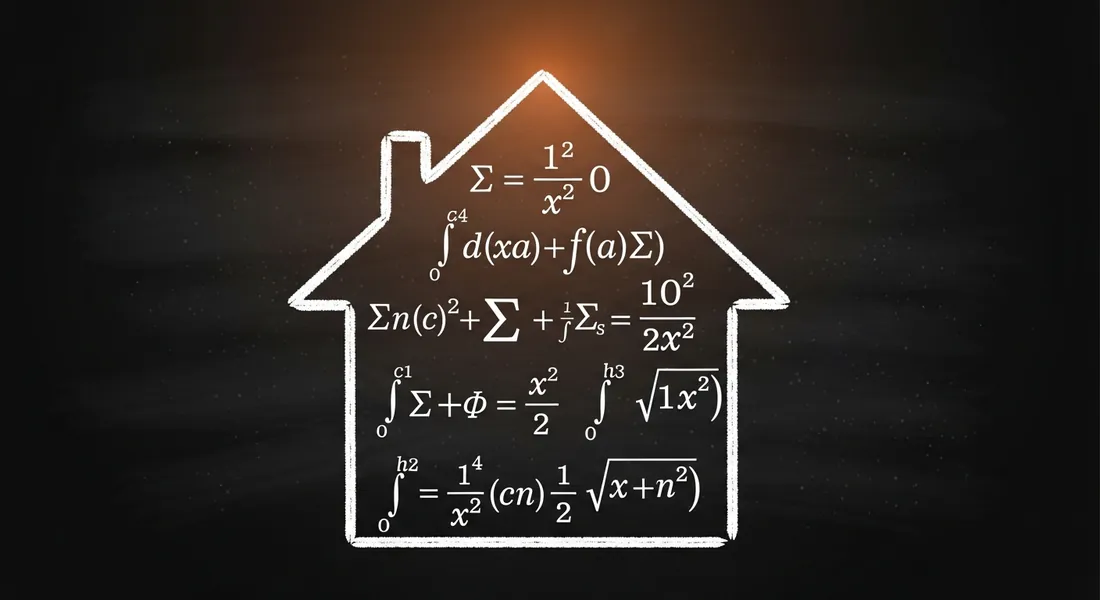
Table of Contents
- The Mortgage Payment Formula
- Breaking Down Each Variable
- Step-by-Step Example: $300,000 Loan
- Second Example: $450,000 Loan
- How the Interest Rate Affects Your Payment
- How Loan Term Changes Everything
- Comparison Tables: Rates and Terms
- Common Mistakes When Using the Formula
- Practical Tips and Shortcuts
- Beyond Principal and Interest
The Mortgage Payment Formula
Every fixed-rate mortgage payment in the world is calculated using the same formula. Whether your lender uses a fancy spreadsheet or a simple calculator, the math underneath is identical. Here it is:
This formula looks intimidating at first glance, but it's actually straightforward once you understand what each letter means. The formula calculates a fixed monthly payment that, over the life of the loan, pays off both the principal (the amount you borrowed) and all the interest (the cost of borrowing). According to the Consumer Financial Protection Bureau (CFPB), understanding this formula is one of the best ways to verify lender quotes and make smarter home buying decisions.
The beauty of this formula is that it produces a single, constant payment amount. Even though the split between principal and interest changes every month, the total you pay stays the same from month one to month 360. That predictability is what makes fixed-rate mortgages so popular — you always know exactly what you owe.
Breaking Down Each Variable
Let's define each piece of the formula so there's no confusion:
- M (Monthly Payment): This is what you're solving for — your fixed monthly principal and interest payment. It does not include property taxes, insurance, or PMI. Those are added separately.
- P (Principal): The loan amount — the total amount you're borrowing. If you're buying a $400,000 home with 20% down ($80,000), your principal is $320,000. This is not the home price; it's the home price minus your down payment.
- r (Monthly Interest Rate): Your annual interest rate divided by 12. If your annual rate is 6.5%, then r = 0.065 ÷ 12 = 0.005417. This is the most common mistake people make — using the annual rate instead of the monthly rate. Always divide by 12.
- n (Total Number of Payments): The loan term in months. A 30-year mortgage has 360 payments (30 × 12). A 15-year mortgage has 180 payments (15 × 12). A 20-year term has 240 payments.
That's it — just four variables. Three inputs (P, r, n) and one output (M). Every mortgage calculator on the planet uses this exact same formula, including Mortgage Pal. The only difference between calculators is whether they also add taxes, insurance, and PMI on top.
Step-by-Step Example: $300,000 Loan
Let's walk through the formula with a real example. Say you're borrowing $300,000 at 6.5% interest for 30 years.
Step 1: Identify your variables
- P = $300,000
- Annual rate = 6.5%, so r = 0.065 ÷ 12 = 0.005417
- n = 30 years × 12 = 360 payments
Step 2: Calculate (1 + r)n
This is the part that requires a calculator. (1 + 0.005417)360 = (1.005417)360 = approximately 6.9913. This number represents the compound growth factor over the life of the loan. It's what makes compound interest so powerful — and so expensive for borrowers.
Step 3: Calculate the numerator
r × (1 + r)n = 0.005417 × 6.9913 = 0.03788
Step 4: Calculate the denominator
(1 + r)n − 1 = 6.9913 − 1 = 5.9913
Step 5: Divide and multiply by P
M = $300,000 × (0.03788 ÷ 5.9913) = $300,000 × 0.006321 = $1,896
Your monthly principal and interest payment is $1,896. Over 30 years (360 payments), you'll pay a total of $682,560 — meaning $382,560 is pure interest on top of your original $300,000 loan. That interest figure often shocks people, but it's the reality of borrowing over three decades.
Verifying the Math
Here's a quick sanity check: multiply $1,896 by 360 payments = $682,560 total. Subtract the original $300,000 loan = $382,560 in total interest. That's about 127% of the original loan amount paid in interest alone. This ratio is typical for 30-year loans in the 6%–7% range. If your calculation produces a ratio much higher or lower, double-check your numbers.
Second Example: $450,000 Loan
Let's try a larger loan to reinforce the process. You're borrowing $450,000 at 7.0% for 30 years.
- P = $450,000
- r = 0.07 ÷ 12 = 0.005833
- n = 360
Calculate (1 + r)n: (1.005833)360 = approximately 8.1165
Numerator: 0.005833 × 8.1165 = 0.04735
Denominator: 8.1165 − 1 = 7.1165
M = $450,000 × (0.04735 ÷ 7.1165) = $450,000 × 0.006653 = $2,994
At 7.0%, the total paid over 30 years is $1,077,840. That's $627,840 in interest — nearly 140% of the loan amount. Compare this to the previous example at 6.5%: that half-percent rate difference on a $450,000 loan costs an additional $96 per month and roughly $34,500 in total interest. Small rate differences have enormous consequences over 30 years.
The Same Loan at 15 Years
Using the same $450,000 at 7.0% but on a 15-year term:
- n = 180 payments
- (1.005833)180 = approximately 2.8490
- M = $450,000 × [0.005833 × 2.8490] / [2.8490 − 1] = $450,000 × 0.008988 = $4,045
The monthly payment jumps from $2,994 to $4,045 — an increase of $1,051/month. But the total paid drops to $728,100, saving you $349,740 in interest compared to the 30-year option. That's nearly $350,000 saved for an extra $1,051/month. This is the trade-off at the heart of every term-length decision.
How the Interest Rate Affects Your Payment
The interest rate is the most impactful variable in the formula (after the loan amount itself). Even small changes compound dramatically over hundreds of payments.
Here's what a $350,000 loan for 30 years looks like at different rates:
| Interest Rate | Monthly P&I | Total Interest | Total Paid |
|---|---|---|---|
| 5.5% | $1,987 | $365,320 | $715,320 |
| 6.0% | $2,098 | $405,280 | $755,280 |
| 6.5% | $2,212 | $446,320 | $796,320 |
| 7.0% | $2,329 | $488,440 | $838,440 |
| 7.5% | $2,447 | $530,920 | $880,920 |
| 8.0% | $2,568 | $574,480 | $924,480 |
The spread between 5.5% and 8.0% is $581/month and $209,160 in total interest. That's more than half the original loan amount in extra interest just from a 2.5% rate difference. This is exactly why rate shopping matters — getting quotes from three or four lenders could save you tens of thousands over the life of your loan. Freddie Mac's Primary Mortgage Market Survey tracks current average rates weekly.
How Loan Term Changes Everything
The number of payments (n) has a massive effect on both your monthly payment and total interest. A shorter term means higher monthly payments but dramatically less total interest paid.
Here's a $350,000 loan at 6.5% across different terms:
| Loan Term | Monthly P&I | Total Interest | Interest Savings vs. 30-Year |
|---|---|---|---|
| 30 years | $2,212 | $446,320 | — |
| 25 years | $2,365 | $359,500 | $86,820 |
| 20 years | $2,607 | $275,680 | $170,640 |
| 15 years | $3,049 | $198,820 | $247,500 |
| 10 years | $3,976 | $127,120 | $319,200 |
Going from a 30-year to a 15-year term increases your payment by $837/month but saves $247,500 in interest. That's an extraordinary return on the extra monthly outlay. And a 20-year term offers a middle ground — only $395/month more than the 30-year, but you save $170,640 and pay off a full decade sooner.
Many financial planners recommend the 20-year term as the sweet spot for borrowers who can afford slightly higher payments. You get meaningful interest savings without the budget strain of a 15-year loan.
Comparison Tables: Rates and Terms
Here's a comprehensive view showing monthly payments for various loan amounts, rates, and terms. Use this as a quick reference:
30-Year Fixed Monthly Payments
| Loan Amount | 6.0% | 6.5% | 7.0% | 7.5% |
|---|---|---|---|---|
| $200,000 | $1,199 | $1,264 | $1,331 | $1,398 |
| $300,000 | $1,799 | $1,896 | $1,996 | $2,098 |
| $400,000 | $2,398 | $2,528 | $2,661 | $2,797 |
| $500,000 | $2,998 | $3,160 | $3,327 | $3,496 |
15-Year Fixed Monthly Payments
| Loan Amount | 5.5% | 6.0% | 6.5% | 7.0% |
|---|---|---|---|---|
| $200,000 | $1,634 | $1,688 | $1,742 | $1,798 |
| $300,000 | $2,451 | $2,532 | $2,613 | $2,697 |
| $400,000 | $3,268 | $3,375 | $3,484 | $3,596 |
| $500,000 | $4,085 | $4,219 | $4,355 | $4,494 |
Keep these tables handy when browsing listings or comparing lender offers. They give you an instant reality check on what any given loan will actually cost per month.
Common Mistakes When Using the Formula
Even with a straightforward formula, errors creep in. Here are the most common pitfalls:
- Using the annual rate instead of monthly: This is mistake number one. If your rate is 6.5%, you must divide by 12 to get 0.005417. Plugging 0.065 into the formula as r will produce a wildly incorrect answer — your payment would appear to be roughly 10 times what it should be.
- Using the home price instead of the loan amount: If you're buying a $400,000 home with 10% down ($40,000), P is $360,000 — not $400,000. This mistake inflates your calculated payment by whatever your down payment percentage is.
- Confusing years with months for n: A 30-year mortgage has 360 monthly payments, not 30. Using n = 30 gives a nonsensical result. Always multiply years by 12.
- Rounding too early: The formula involves exponents and small decimal numbers. Rounding the monthly rate to 0.005 instead of 0.005417 (for a 6.5% loan) changes the payment by about $40/month. Carry at least 4 decimal places through each step.
- Forgetting it's P&I only: The formula calculates principal and interest. Your actual monthly payment will be higher once you add property taxes, homeowners insurance, and PMI. See our complete payment calculation guide for the full picture.
- Applying the formula to adjustable-rate mortgages: This formula works for fixed-rate loans. Adjustable-rate mortgages (ARMs) change rates periodically, so you'd need to recalculate each time the rate adjusts.
Practical Tips and Shortcuts
You don't need to hand-calculate the formula every time — but understanding it gives you superpowers when evaluating lender offers. Here are some practical tips:
- The $6.32 rule of thumb: At a 6.5% rate on a 30-year loan, every $1,000 borrowed costs approximately $6.32/month. So a $300,000 loan ≈ $1,896/month, and a $350,000 loan ≈ $2,212/month. This mental shortcut lets you estimate payments in your head while browsing listings.
- Quick rate impact: On a $300,000 loan for 30 years, each 0.5% rate change moves your payment by about $100/month. So if rates go from 6.5% to 7.0%, expect roughly $100 more per month.
- Use a calculator, but verify: Apps like Mortgage Pal do the math instantly and accurately. But when a lender gives you a quote, knowing the formula lets you verify their numbers. If their quoted payment doesn't match within a few dollars, ask questions.
- Calculate total cost, not just monthly: Always multiply your monthly payment by the number of payments to see total cost. A $100/month savings over 30 years is $36,000 — that context matters when deciding between lender offers or rate lock options.
- The double-check trick: Your first month's interest should equal P × r. On a $300,000 loan at 6.5% (r = 0.005417), month one's interest = $1,625. If the lender's amortization schedule shows a different first-month interest, something doesn't match. Read our amortization schedule guide for more on this.
When to Use the Formula vs. a Calculator
Be honest: you'll almost never solve this formula by hand. And you don't need to. The real value of understanding it is knowing which inputs matter most, spotting errors in lender quotes, and understanding why small rate changes have such big consequences.
Use a mortgage calculator app for quick estimates while house shopping. Use the formula knowledge to ask smarter questions: "What would my payment be if I bought down the rate by 0.25%?" or "How much do I save by putting 15% down instead of 10%?" When you understand the math, you negotiate from a position of strength.
Beyond Principal and Interest
The mortgage formula gives you the P&I portion of your payment, but your actual monthly cost is higher. Here's what gets added on top:
- Property taxes: Typically 0.5%–2.5% of the home's value annually. On a $375,000 home at 1.1%, that's $344/month added to your payment.
- Homeowners insurance: Usually $100–$250/month depending on location and coverage. Coastal and fire-prone areas pay significantly more.
- PMI: Required if your down payment is under 20%. Adds $150–$350/month on a typical loan. Goes away once you reach 20% equity.
- HOA fees: If applicable, can range from $150–$600+/month for condos and planned communities.
For our $300,000 loan example with a P&I payment of $1,896, your total monthly cost including taxes, insurance, and PMI could realistically be $2,500–$2,900. That's 30%–50% more than the formula alone suggests. Always calculate the full picture before committing to a home purchase. Our guide on how much house you can afford walks you through building a complete budget.
The mortgage payment formula is the foundation of every home purchase decision. Master it, and you'll never be surprised by a lender's numbers again. Whether you're a first-time buyer or refinancing your existing loan, understanding the math behind your payment puts you in control of one of the biggest financial decisions of your life.
Trusted by thousands of homeowners, realtors, and mortgage professionals.
Mortgage Pal is the #1 rated mortgage calculator app on the App Store. It's 100% free to use. Download today and try for yourself.

⭐ 4.8/5.0 • 3,300+ Reviews • 100% Free