How to Calculate Your Monthly Mortgage Payment
Table of Contents
The 5 Components of Your Payment
When people talk about their "mortgage payment," they usually mean the total amount they send to their lender each month. But that single payment actually covers up to five different costs, often referred to as PITI (plus PMI):
- Principal: The portion that reduces your loan balance — this is the money that builds your equity
- Interest: The cost of borrowing money — what the bank charges you for the privilege of the loan
- Taxes: Property taxes collected by your local government, typically held in escrow
- Insurance: Homeowners insurance to protect your property against damage and liability
- PMI: Private mortgage insurance if you put less than 20% down — protects the lender, not you
Understanding each component helps you see where your money goes and where you might be able to save. According to HUD (U.S. Department of Housing and Urban Development), housing costs should ideally stay below 30% of your gross monthly income.
Here's something that surprises most people: on a typical 30-year mortgage, the principal and interest portion only accounts for about 60%–70% of your total monthly housing cost. Taxes, insurance, and PMI make up the rest — and those costs are easy to overlook when you're focused on finding the right rate.
Calculating Principal and Interest
Principal and interest make up the core of your mortgage payment. The standard formula uses your loan amount, monthly interest rate, and total number of payments. Don't worry — you don't need to do this math by hand. But here's how it works:
For a $300,000 loan at 6.5% for 30 years:
- Monthly interest rate: 6.5% ÷ 12 = 0.5417%
- Number of payments: 30 × 12 = 360
- Monthly P&I payment: $1,896
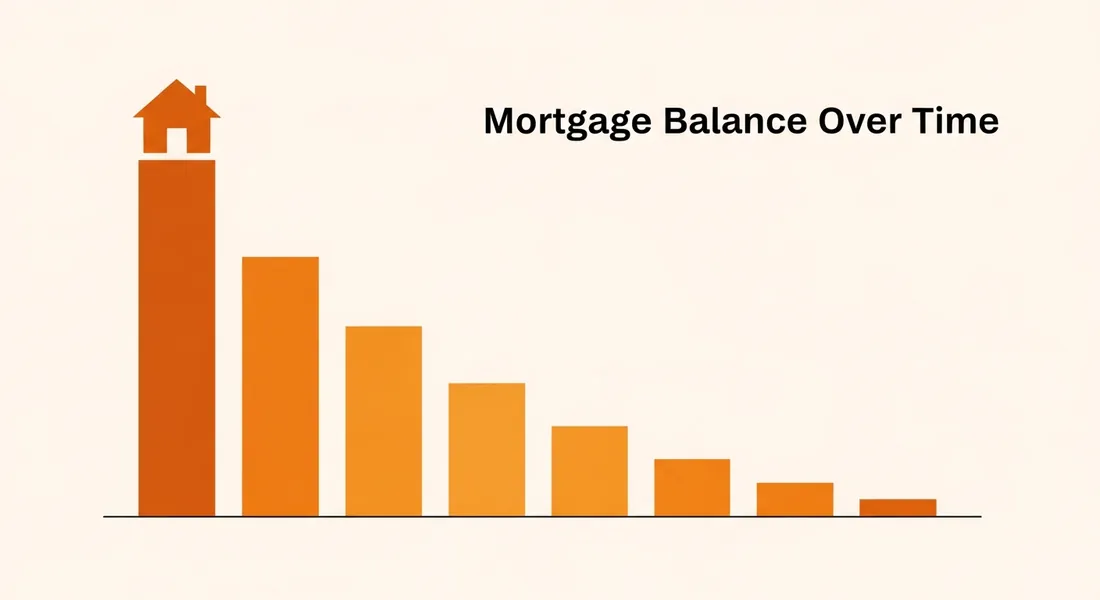
In the early years of your loan, most of your payment goes toward interest. On that $300,000 loan, your first payment splits roughly $1,625 to interest and only $271 to principal. By year 20, that flips — about $1,050 goes to principal and $846 to interest. For a deeper look, read our guide on understanding amortization schedules.
Why the Split Matters for Your Wealth
Here's a reality check: in your first year of payments on a $300,000 loan at 6.5%, you'll pay $19,385 in interest and only $3,367 in principal. That means of the $22,752 you send to your lender in year one, only 14.8% actually reduces your loan balance. The rest is the cost of borrowing.
This is exactly why understanding amortization matters. If you're planning to sell within 3–5 years, you'll have built surprisingly little equity through mortgage payments alone. Your equity gains will come primarily from appreciation, not from paying down the loan. For the full formula breakdown, see our mortgage payment formula guide.
Adding Property Taxes
Property taxes vary dramatically by location. The national average is about 1.1% of the home's assessed value, but it ranges from 0.27% in Hawaii to over 2.2% in New Jersey and Texas.
For a $375,000 home at a 1.1% tax rate:
- Annual property tax: $4,125
- Monthly property tax: $344
Your lender typically collects this monthly and holds it in an escrow account, paying the tax bill on your behalf. Keep in mind that property taxes can increase over time as your home's assessed value rises — sometimes significantly. In hot markets, homeowners have seen their tax bills jump 15%–20% in a single reassessment.
Property Tax Rates by State: What to Expect
Here's a sampling of effective property tax rates to give you context:
- New Jersey: 2.23% — on a $375,000 home, that's $697/month
- Texas: 1.80% — $563/month
- California: 0.75% — $234/month
- Florida: 0.89% — $278/month
- Colorado: 0.51% — $159/month
The same $375,000 home costs $538/month more in property taxes in New Jersey than in Colorado. This is why location matters as much as purchase price when calculating your true housing cost.
Homeowners Insurance Costs
Homeowners insurance protects you against damage from events like fire, storms, and theft. The average annual premium in the U.S. is about $1,900, though it varies significantly by state and coverage level.
For our example:
- Annual insurance premium: $1,900
- Monthly insurance cost: $158
Like taxes, insurance is usually collected through your escrow account. If your home is in a flood zone, you'll also need flood insurance, which averages about $700–$1,000 per year. In coastal Florida or Louisiana, flood insurance can run $2,500–$5,000 or more annually.
Insurance costs have been rising sharply in recent years due to increased natural disaster frequency. States like Florida, Louisiana, and California have seen premium increases of 30%–60% since 2020. Factor in potential increases when budgeting for the long term.
Private Mortgage Insurance (PMI)
If your down payment is less than 20% of the home's value, your lender will require PMI. This protects the lender (not you) in case you default on the loan.
PMI typically costs between 0.5% and 1.5% of the original loan amount per year. On a $337,500 loan (10% down on a $375,000 home):
- PMI rate: 0.75% (mid-range estimate)
- Annual PMI cost: $2,531
- Monthly PMI: $211
The good news? PMI isn't forever. Once you reach 20% equity, you can request its removal. At 22% equity, your lender must remove it automatically under the Homeowners Protection Act. Learn more in our PMI calculator guide.
Your credit score heavily influences your PMI rate. A borrower with a 760+ credit score might pay just 0.3% annually, while someone with a 660 score could pay 1.2% or more. On a $337,500 loan, that's the difference between $84/month and $338/month — a $254 monthly swing based solely on credit score.
Full Payment Example: $375,000 Home
Let's put it all together for a $375,000 home with 10% down ($37,500) at 6.5% interest on a 30-year term:
- Loan amount: $337,500
- Principal & interest: $2,133
- Property taxes (1.1%): $344
- Homeowners insurance: $158
- PMI (0.75%): $211
- Total monthly payment: $2,846
That's a significant difference from the $2,133 principal-and-interest-only figure you might see on a basic calculator. Always make sure you're looking at the full PITI+PMI number when budgeting for a home.
And don't forget: this doesn't include maintenance ($312–$625/month if you budget 1%–2% of home value), utilities ($200–$400/month for a typical home), or HOA fees if applicable. Your true monthly cost of homeownership on a $375,000 property could realistically be $3,400–$4,000+.
How Escrow Accounts Work
Most lenders require you to pay taxes and insurance through an escrow account. Here's how it works:
- Your lender estimates your annual tax and insurance costs
- They divide those costs by 12 and add that amount to your monthly mortgage payment
- The money sits in an escrow account managed by your loan servicer
- When your tax bill or insurance premium is due, the servicer pays it from escrow
Each year, your lender performs an escrow analysis. If they've collected too much, you'll get a refund. If too little, you'll face an escrow shortage — meaning your monthly payment increases to cover the deficit. This is why your mortgage payment can go up even with a fixed-rate loan.
A common scenario: your property tax assessment increases by $500/year after reassessment. Your escrow account comes up short, and your lender increases your monthly payment by about $42/month to cover it. This is normal, but it catches many homeowners off guard.
Ways to Reduce Your Payment
If your calculated payment feels too high, you have several options:
- Increase your down payment: Going from 10% to 20% down on our $375,000 example eliminates PMI and reduces the loan amount, dropping your payment from $2,846 to about $2,455 — a savings of nearly $400/month.
- Shop for a better rate: Getting 6.0% instead of 6.5% on a $337,500 loan saves about $113/month. Over 30 years, that's $40,680.
- Choose a less expensive home: Sometimes the best financial move is adjusting your price range. Use our affordability calculator guide to find your sweet spot.
- Consider a longer term: While we generally recommend shorter terms for interest savings, a 30-year term keeps payments lower than a 15-year. See our 15 vs 30-year comparison.
- Appeal your property tax assessment: If you believe your home is over-assessed, you can file an appeal with your county assessor. Success rates vary, but homeowners who appeal save an average of $1,000–$3,000 per year.
- Shop insurance annually: Insurance rates vary wildly between companies. Getting quotes every 1–2 years can save $300–$800/year without reducing coverage.
Common Calculation Errors to Watch For
Even experienced buyers make these mistakes when calculating mortgage payments:
- Using the home price instead of the loan amount: If you're buying a $375,000 home with 10% down, your loan is $337,500 — not $375,000. Using the wrong number inflates your P&I calculation by about $250/month.
- Forgetting to convert the annual rate: The mortgage formula needs a monthly rate. Divide the annual rate by 12. Using 6.5 instead of 0.5417 in the formula will give you a wildly incorrect answer.
- Comparing P&I-only to full PITI: If lender A quotes you $2,133/month (P&I only) and lender B quotes $2,750 (full PITI), don't assume lender A is cheaper. They might be showing you an incomplete picture.
- Ignoring PMI when comparing down payment scenarios: A 5% down payment might seem appealing until you realize PMI adds $200–$350/month to your costs for the first 5–10 years.
The key is understanding every piece of your monthly payment so you can make informed decisions. Knowledge is power when it comes to the biggest purchase of your life.
Putting It All Together: Three Budget Scenarios
Let's compare the full monthly cost for a $375,000 home across three different buyer profiles to show how down payment, credit score, and location dramatically change your real payment.
Buyer A: Strong Position
20% down ($75,000), 6.25% rate (excellent credit, 780+ score), lives in Colorado (0.51% property tax).
- Loan: $300,000 | P&I: $1,847
- Property taxes: $159/month | Insurance: $125/month
- PMI: $0 (20% down) | HOA: $0
- Total monthly: $2,131
Buyer B: Moderate Position
10% down ($37,500), 6.75% rate (good credit, 720 score), lives in Florida (0.89% tax, high insurance).
- Loan: $337,500 | P&I: $2,189
- Property taxes: $278/month | Insurance: $317/month
- PMI: $211/month | HOA: $200/month (condo)
- Total monthly: $3,195
Buyer C: Stretching
5% down ($18,750), 7.25% rate (fair credit, 660 score), lives in New Jersey (2.23% tax).
- Loan: $356,250 | P&I: $2,430
- Property taxes: $697/month | Insurance: $150/month
- PMI: $356/month (1.2% rate due to lower credit) | HOA: $0
- Total monthly: $3,633
Same $375,000 home — payments ranging from $2,131 to $3,633. That's a $1,502/month spread driven by down payment, credit score, location, and insurance costs. This is why calculating every component matters. Buyer C pays 70% more per month than Buyer A for the exact same property.
The lesson is clear: improving your credit score, saving a larger down payment, and carefully choosing your location can save you hundreds of dollars every single month. Use our affordability guide to determine the right home price for your specific situation, and check the Freddie Mac rate survey for current rate benchmarks based on credit tiers.
Trusted by thousands of homeowners, realtors, and mortgage professionals.
Mortgage Pal is the #1 rated mortgage calculator app on the App Store. It's 100% free to use. Download today and try for yourself.

⭐ 4.8/5.0 • 3,300+ Reviews • 100% Free